Building Goldminds: How Two Parents Built a Children's Sleep App
March 03, 2026
Over the past two years, I've been building Goldminds, a children's sleep and mindfulness app, alongside my co-founder Cynthia. What started as a scrappy idea between two parents has turned into an app that hundreds of families use every night as part of their bedtime routine. This is the story of how we built it.

Finding a Co-founder
In late 2023, I was browsing Y Combinator's co-founder matching platform. The premise is simple: founders looking for co-founders post profiles describing what they're working on and what they're looking for. You swipe, you match, you chat. I had been noodling on ideas in the children's content space for a while, so when I matched with Cynthia, it clicked fast.
Cynthia is based in Burlington, Ontario. I'm in Kingston. We're both parents of two kids, both deeply familiar with the nightly struggle of getting small humans to actually close their eyes and sleep. We'd both independently arrived at the same observation: bedtime is stressful for so many families, and the existing solutions were either low quality, overpriced, or riddled with ads. We decided to build something better.
Getting Started (Late 2023)
Two days after Christmas 2023, while the kids played with their new toys, I started building. React frontend, Flask backend. Within a week we had a working intro screen, navigation, and the bones of an app. The excitement of a new project is a powerful motivator.
The First Features (Early 2024)
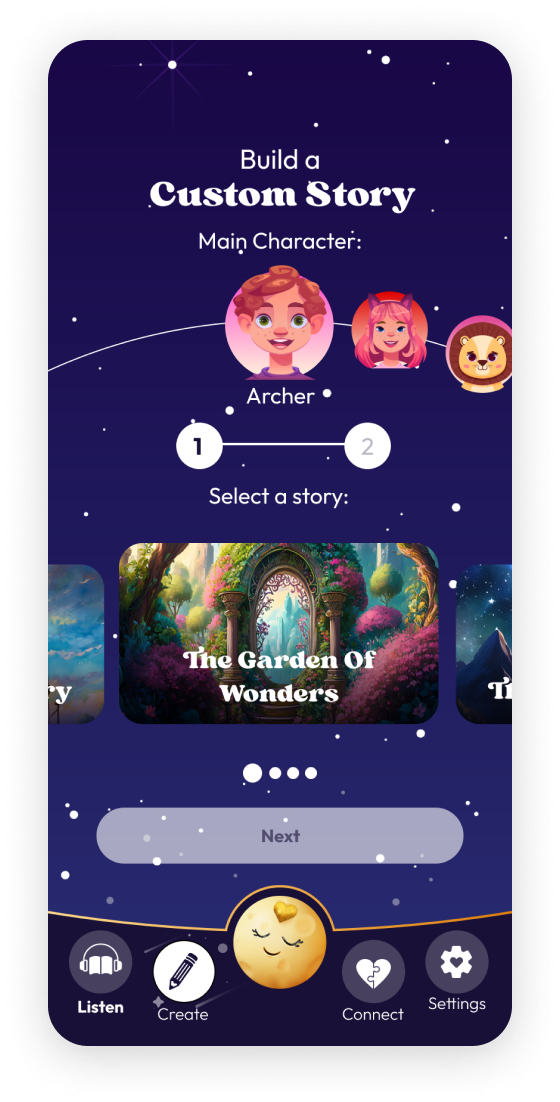
January and February were about building the product skeleton: sign up and login, a media player, search, and an admin panel for managing content. By the end of January we had a working app, just one with nothing in it yet.
February was when Goldminds started to become Goldminds. We built the story generation system and experimented with different text-to-speech approaches, iterating on how to weave mindfulness techniques into children's stories naturally. Each story needed to feel like a bedtime story a parent would tell, not a guided meditation with a script.
We also built child profiles within family accounts. Parents could add their kids, and stories would be personalized to each child. Your kid becomes the protagonist. Their name is spoken aloud by the narrator. This feature became one of our biggest differentiators.
Custom Story Builder (March 2024)
By mid-March, the custom story generator was fully working. You enter a child's name, pick a theme, and Goldminds generates a unique, personalized relaxation story.
March also brought the first real mobile builds. Capacitor let us target iOS, Android, and web from a single codebase. We added day and night mode for the app (calmer colors at bedtime) and set up Docker, Redis, and task queues for the backend.
App Store Launch (Summer 2024)
Getting an app into the App Store is its own adventure. May and June were dominated by subscriptions, in-app purchases, and the review process. We submitted to both the App Store and Google Play. A referral system went live. Word of mouth from parents who already love the app became our best growth channel.
Gamification: The Treasure Map (August 2024)
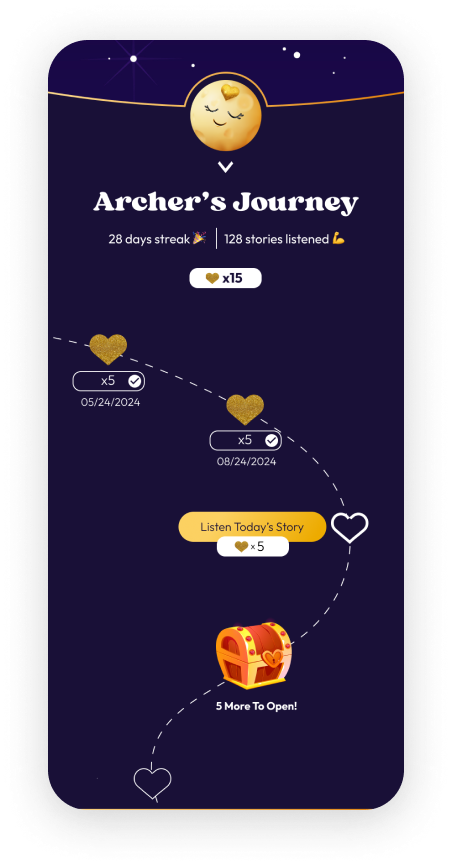
Kids are motivated by progress. In August we added a treasure map where children earn gold for listening to stories, building streaks and unlocking new levels. It turned "time to go to sleep" from a chore into something kids actually look forward to. Parents started telling us their kids were asking to go to bed. That was when we knew we were onto something.
Around the same time, we upgraded our text-to-speech to neural voices for more natural-sounding narration and added the "pronounce name" feature so the narrator says each child's name correctly.
Going Live (October 2024)
October 2024 was when real families started using Goldminds in production. The nervous energy of watching real users interact with something you built is hard to describe. We iterated fast, shipping fixes and improvements daily.
Self-Hosted AI (Early 2025)
By the end of 2024, cloud API calls for story generation were getting expensive and we wanted more control over voice quality and story style. So we built a self-hosted GPU server running Llama for text generation and custom models for audio processing with PyTorch on CUDA.
The motivation was cost and control. When you can change a model and deploy in minutes instead of waiting for a third-party API provider, you move faster. It was a significant undertaking, but worth it.
2025: Content and Discovery
With the core product solid, 2025 was about making it easier to find and enjoy content:
- Explore page: A proper content discovery experience for browsing stories by theme, age, and mood
- Closed captioning: Accessibility for all families
- Music after stories: Five minutes of ambient music after each story, so the transition to sleep is gradual
- Featured playlists: Curated story collections for different situations
- Custom playlists: Parents and kids build their own story collections
- Onboarding video: Show new users what Goldminds is about before they dive in
Polish and Scale (Late 2025 - 2026)
The latest phase has been about removing friction. Social login with Google and Apple means no more password creation for new parents. We completely revamped the onboarding experience. Offer codes and redemption pages enabled partnerships and promotions.
In early 2026, a major UI overhaul landed alongside smarter story recommendations powered by vector search. The app feels like a different product compared to where we started, and that's the point.
The Stack Today
For the technically curious, here's what powers Goldminds:
- Frontend: React, TypeScript, Ionic, Capacitor (iOS, Android, and web from one codebase)
- Backend: Flask, PostgreSQL, Redis, Nginx
- AI/ML: Self-hosted GPU server for story generation, Google Cloud TTS for narration, PyTorch on CUDA for audio processing, pgvector for semantic search
- Infrastructure: Dokku, Docker, S3-compatible storage, Sentry, RevenueCat for subscriptions
What I've Learned
Building Goldminds has been the most rewarding project of my career. A few takeaways:
Build what you need. Cynthia and I are both parents who struggled with bedtime. We didn't need market research to validate the problem. We lived it every night.
Ship early, iterate fast. Our first version was rough. The stories were basic, the UI was clunky, the infrastructure was held together with hope. But it worked, and every week it got better.
Self-hosting AI is worth it. Moving from cloud APIs to our own GPU server gave us control over quality, cost, and iteration speed.
Kids are honest users. If a story is boring, they'll tell you. If the app is confusing, they'll give up. There's no polite tolerance. It's the best feedback loop you could ask for.
If you have kids and bedtime is a battle, give Goldminds a try. It's available on the App Store and Google Play. And if you're a developer thinking about building something on the side, find a co-founder who believes in the same problem you do. It makes all the difference.
Happy building!